Welcome to the ultimate guide to making the perfect Raspberry Macaron Recipe right in your own kitchen. Forget the bakery intimidation! We’re breaking down this elegant French pastry into simple, manageable steps. This recipe is designed for the enthusiastic home cook, yielding delicate, crisp shells, chewy centers, and a vibrant raspberry buttercream filling that bursts with flavor. Get ready to impress yourself, your family, and your friends.
Whether you’re a first-timer or looking to perfect your technique, this guide is packed with tips and tricks to ensure your success. We will walk through everything from achieving the perfect meringue to the crucial “macaronage” stage. Let’s bake something beautiful together!

Why You’ll Love This Foolproof Raspberry Macaron Recipe
- Incredibly Detailed Steps: We leave no stone unturned, guiding you through each phase of the process for consistent results.
- Vibrant Raspberry Flavor: Using raspberry powder in the buttercream provides an intense, authentic fruit flavor without compromising the filling’s texture.
- Perfect Texture: Achieve that coveted combination of a delicate, crisp shell and a delightfully chewy interior.
- Troubleshooting Tips: We’ve included a comprehensive section to solve common macaron issues, from hollow shells to cracked tops.
Ingredients You’ll Need
Precision is key in macaron making. We highly recommend using a kitchen scale for the most accurate measurements.
For the Macaron Shells
- 100g aged egg whites (about 3 large eggs)
- 90g granulated sugar
- 130g almond flour, finely ground
- 150g powdered sugar
- 1/4 tsp cream of tartar
- 1-2 drops pink or red gel food coloring
For the Raspberry Buttercream Filling
- 1/2 cup (113g) unsalted butter, softened
- 1 1/2 cups (180g) powdered sugar
- 3 tbsp raspberry powder (freeze-dried raspberries, blended)
- 1 tbsp milk or heavy cream
- 1/2 tsp vanilla extract

Essential Baker’s Tools
Having the right equipment is half the battle. Here’s what you’ll need:
- Digital kitchen scale
- Stand mixer with a whisk attachment (or a hand mixer)
- Sifter or fine-mesh sieve
- Piping bags and a round piping tip (like a Wilton 12)
- Baking sheets
*Silicone baking mats or parchment paper with a macaron template
How to Make Raspberry Macarons: A Step-by-Step Guide
Follow these instructions carefully to create bakery-quality raspberry macarons. This process may seem detailed, but each step is crucial for the final result.
Step 1: Prep Your Ingredients (Mise en Place)
Start by weighing all your ingredients accurately. Sift the almond flour and powdered sugar together into a large bowl. Sift them twice to ensure there are no lumps, which is key for smooth macaron shells. Wipe down your mixing bowl and whisk with a little vinegar to remove any traces of fat, which can prevent your meringue from whipping up properly.
Step 2: Make the French Meringue
In the clean bowl of your stand mixer, combine the egg whites and cream of tartar. Whisk on medium-low speed until foamy. Slowly start adding the granulated sugar, one tablespoon at a time, while the mixer is running. Once all the sugar is incorporated, increase the speed to medium-high. Continue to whip until the meringue forms stiff, glossy peaks. This means when you lift the whisk, the peak holds its shape without drooping. Add your gel food coloring in the last minute of mixing.
Step 3: The “Macaronage” Process
Gently fold the sifted almond flour and powdered sugar mixture into the meringue in three additions. This stage, called “macaronage,” is the most critical. You want to fold the batter by scraping around the bowl and then pressing down through the middle. The goal is to deflate some air until the batter reaches a “lava-like” consistency. It should fall off your spatula in a thick, continuous ribbon. A great way to test this is to see if you can draw a figure-8 with the ribbon of batter without it breaking.
Step 4: Piping the Macaron Shells
Transfer the batter to a piping bag fitted with a round tip. Pipe 1.5-inch circles onto your prepared baking sheets, leaving about an inch of space between each one. After piping, rap the baking sheets firmly on the counter a few times to release any air bubbles. You can pop any remaining bubbles with a toothpick.
Step 5: Resting and Drying the Shells
Let the piped macarons rest at room temperature for 30-60 minutes, or until they form a dry skin. When you can gently touch the top of a macaron without any batter sticking to your finger, they are ready to bake. This drying step is essential for developing the characteristic “feet.”
Step 6: Baking to Perfection
Preheat your oven to 300°F (150°C). Bake the macarons for 15-17 minutes, one sheet at a time. To check for doneness, gently nudge the top of a macaron. If it doesn’t wiggle, it’s done. Let the shells cool completely on the baking sheet before attempting to remove them.
Step 7: Making the Raspberry Buttercream
While the shells cool, prepare the filling. In a bowl, beat the softened butter until creamy. Gradually add the powdered sugar and raspberry powder, mixing until smooth. Add the vanilla and milk or cream and beat until light and fluffy.
Step 8: Assembling Your Raspberry Macarons
Transfer the buttercream to a piping bag. Pipe a small dollop onto the flat side of one macaron shell and gently sandwich it with another shell. For the best flavor and texture, mature the assembled macarons in an airtight container in the refrigerator for 24 hours before serving. This allows the filling to soften the shells slightly. For another delicious dessert, try this Italian Lemon Custard Cake recipe.
Pro Tips for Perfect Macarons Every Time
- Use a Kitchen Scale: This is non-negotiable for macarons. Volume measurements are not precise enough.
- Age Your Egg Whites: Separate your eggs and let the whites sit in the fridge, lightly covered, for 24 hours. This dehydrates them slightly and leads to a more stable meringue.
- Don’t Undermix or Overmix: The macaronage stage is crucial. Under-mixing leads to lumpy, cracked shells, while over-mixing results in flat, spread-out macarons. Aim for that perfect lava-like flow.
- Know Your Oven: Ovens can have hot spots. Rotate your baking sheet halfway through baking to ensure even cooking. An oven thermometer is a great investment. If you enjoy baking, you should also check out this No-Knead Rosemary Garlic Bread.
Troubleshooting Common Macaron Problems
Why Are My Macarons Hollow?
Hollow macarons are often caused by an over-whipped meringue or an under-baked shell. Ensure your meringue has stiff, glossy peaks but isn’t dry or chunky. Also, make sure the shells are baked through and don’t wiggle on the mat.
Why Don’t My Macarons Have “Feet”?
The lack of “feet” (the frilly bottom edge) usually means the shells didn’t rest long enough to form a proper skin. This skin traps the air, forcing it to escape out the bottom, creating the feet. Ensure they are dry to the touch before baking.
Why Are My Macarons Cracked?
Cracking is typically due to excess air bubbles in the batter. Be sure to rap your trays firmly on the counter after piping to release them. Over-mixed batter can also be a cause. Looking for a savory dish? This Garlic Parmesan Chicken Pasta is a must-try.
It’s best to avoid fresh raspberries in buttercream as their water content can cause it to separate. We recommend using raspberry powder (made from freeze-dried raspberries) for an intense flavor without excess moisture.
While not strictly necessary for every baker, aging egg whites by letting them sit in the fridge for 24 hours can help dehydrate them, leading to a stronger, more stable meringue. We highly recommend it for consistency.
Your macarons are done when the ‘feet’ are well-formed and the top of the shell doesn’t wiggle when you gently nudge it. They should peel off the mat easily once they have cooled completely.
Macaronage is the process of folding the dry ingredients into the meringue. It’s the most crucial step, as it deflates the right amount of air to create the perfect consistency. The goal is a batter that flows like a thick ribbon or ‘lava’.
Hollow macarons are typically caused by an over-whipped meringue or under-baking. Ensure your meringue has stiff, glossy peaks but isn’t dry, and bake until the shells no longer wiggle on the mat.
It’s best to avoid fresh raspberries in buttercream as their water content can cause it to separate. We recommend using raspberry powder (made from freeze-dried raspberries) for an intense flavor without excess moisture.
While not strictly necessary for every baker, aging egg whites by letting them sit in the fridge for 24 hours can help dehydrate them, leading to a stronger, more stable meringue. We highly recommend it for consistency.
Your macarons are done when the ‘feet’ are well-formed and the top of the shell doesn’t wiggle when you gently nudge it. They should peel off the mat easily once they have cooled completely.
Macaronage is the process of folding the dry ingredients into the meringue. It’s the most crucial step, as it deflates the right amount of air to create the perfect consistency. The goal is a batter that flows like a thick ribbon or ‘lava’.
Hollow macarons are typically caused by an over-whipped meringue or under-baking. Ensure your meringue has stiff, glossy peaks but isn’t dry, and bake until the shells no longer wiggle on the mat.
Storing Your Raspberry Macarons
Store assembled macarons in an airtight container in the refrigerator for up to 3 days. They are best after “maturing” for 24 hours. You can also freeze the shells or assembled macarons for up to a month. Bring them to room temperature before serving.
Share Your Creations!
We hope you love this Raspberry Macaron Recipe! There is nothing more satisfying than mastering this classic French dessert. If you make them, please leave a comment below or tag us on Pinterest. We love seeing your beautiful creations!
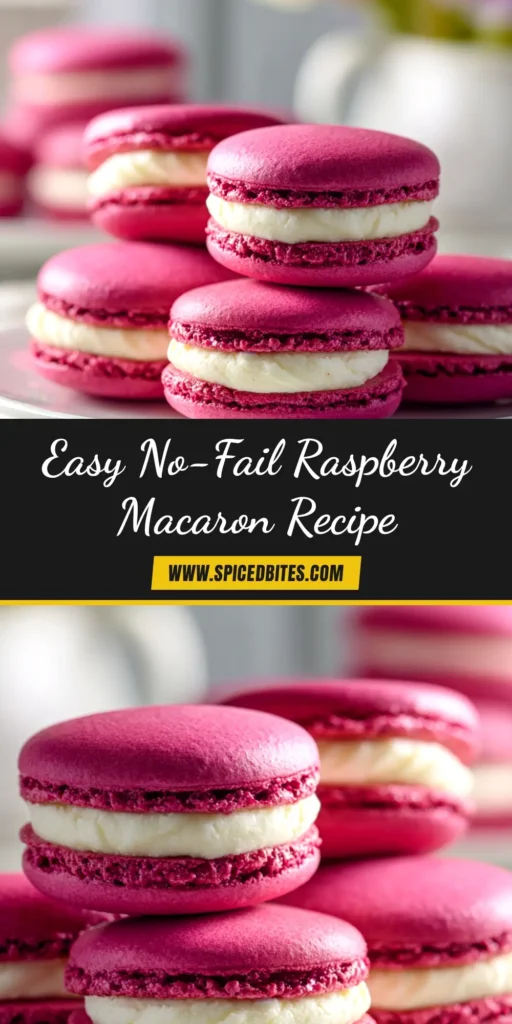
Raspberry Macaron Recipe
Raspberry Macaron Recipe (That's Actually Easy!)
Equipment
- 1 Digital Kitchen Scale
- 1 Stand Mixer
- 2 Piping bags
- 2 Baking Sheets
Ingredients
For the Macaron Shells
- 100 g aged egg whites about 3 large eggs
- 90 g granulated sugar
- 130 g almond flour finely ground
- 150 g powdered sugar
- 0.25 tsp cream of tartar
- 2 drops pink gel food coloring
For the Raspberry Buttercream Filling
- 0.5 cup unsalted butter softened
- 1.5 cups powdered sugar
- 3 tbsp raspberry powder from freeze-dried raspberries
- 1 tbsp milk or heavy cream
- 0.5 tsp vanilla extract
Instructions
Macaron Shells
- Prep Ingredients: Weigh all ingredients. Sift almond flour and powdered sugar together twice into a large bowl. Wipe your mixing bowl and whisk with vinegar to ensure they are free of any fat.
- Make Meringue: Combine egg whites and cream of tartar in a stand mixer. Whisk on medium-low until foamy. Slowly add granulated sugar. Increase speed to medium-high and whip until stiff, glossy peaks form. Add gel food coloring in the last minute of mixing.
- Macaronage: Fold the almond flour mixture into the meringue in three parts. Continue to fold until the batter flows like lava and you can form a figure-8 with the ribbon of batter falling from the spatula.
- Piping: Transfer batter to a piping bag with a round tip. Pipe 1.5-inch circles onto silicone or parchment-lined baking sheets. Rap the trays firmly on the counter to release air bubbles.
- Resting: Let the piped macarons rest at room temperature for 30-60 minutes, until a dry skin forms.
- Baking: Preheat oven to 300°F (150°C). Bake for 15-17 minutes, until the tops do not wiggle. Let cool completely on the baking sheet.
Raspberry Buttercream and Assembly
- Make Buttercream: Beat softened butter until creamy. Gradually mix in powdered sugar and raspberry powder. Add vanilla and milk, and beat until light and fluffy.
- Assemble: Pipe buttercream onto the flat side of one macaron shell and sandwich with another. For best results, refrigerate in an airtight container for 24 hours before serving.
Notes
Aging egg whites for 24 hours in the refrigerator can lead to a more stable meringue.
Let the finished macarons 'mature' in the fridge for 24 hours to develop the best flavor and chewy texture.


